
Information Failure Modes in Networked Violence
“Elijah Morgan has developed an original and credible analytical framework for thinking about networked violence… His work is serious, rigorous, and highly relevant to criminological efforts to understand emerging forms of technologically mediated harm.” M Jenny Edwards, Criminologist
“Over a period of years, I examined the emergence of networked animal torture as a structural phenomenon.
Across platform architectures, incentive regimes, and distribution mechanics, the findings converge on a single conclusion: the persistence and scaling of this harm is a product of infrastructure-level design choices operating in the absence of adequate regulatory constraint.”
https://doi.org/10.5281/zenodo.19599230 / (print) https://www.amazon.co.uk/Information-Failure-Modes-Networked-Violence/dp/B0GTWPQVWP
This book is useful for anyone interested in anti-crush/animal torture activism, violent or extremist networks analysis, or government policy/law enforcement to restrict and disempower transnational sadist operations.
The problem space: cyber-enabled, transnational, monetized animal torture networks use offshore platforms, cryptocurrency payment channels, and distributed spectatorship to convert cruelty into repeatable, commissioned media. Domestic law then collapses the harm into low-level public-order enforcement because animal abuse, child protection, platform circulation, cross-border payment, and evidentiary contamination are split across incompatible legal categories.
IFMNV is intended for investigators, journalists, platform-governance researchers, legal actors, policy workers, and enforcement bodies, but it is also for anyone who needs clear paths to effective action, not outrage.
Print edition
PDF (free): https://doi.org/10.5281/zenodo.19599230
QUOTATIONS
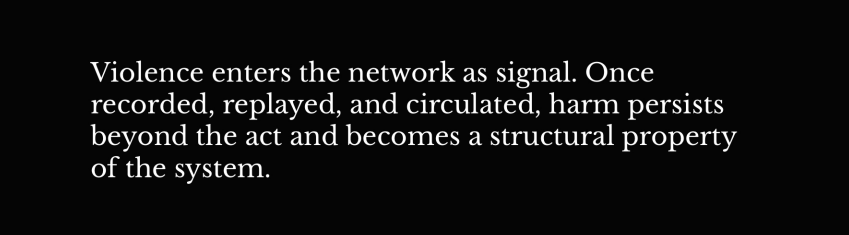
“Classical accounts of violence treat harm as an event: a perpetrator acts, a body is injured, a witness observes. Response mechanisms (responsibility, repair, enforcement) are anchored to that moment. Networked cruelty breaks this model. Once recorded, encoded, and transmitted, the act persists independently of its initial conditions. The recorded suffering functions as a transmissible signal. Each replay, repost, crop, or transformation reproduces exposure to the same harm-content without repeating the original act. The representation of the wound becomes persistent within the system.” from ‘Information Failure Modes in Networked Violence’
https://doi.org/10.5281/zenodo.19599230

Elijah Morgan
Information Failure Modes in Networked Violence
“The purpose of this text is narrow and exacting. It does not argue for better values. It does not propose reform programs. It does not promise resolution. It collapses attribution ambiguity to the point where the system must either internalize cost or openly refuse to do so. Once that line is crossed, there is no neutral position left. The system can continue to function only by admitting that it is actively selecting for harm under conditions of preserved deniability.” from ‘Information Failure Modes in Networked Violence’
https://doi.org/10.5281/zenodo.19599230
Elijah Morgan
Information Failure Modes in Networked Violence
Published: 2026/03/26
Codeberg (https://codeberg.org/PlayDarkly) provides lemmas, formal notes, equations, and supporting technical material.